Moments that connect us to ourselves and to our children.
She doesn't need you to make it better. She needs you to stay close while it's hard.
Four picture books about Ari, her toy Fox and Dad. Each is one small family moment: a fort that has to come down, a hug she didn't want, a promise that broke, a voice that got too loud. And each is a way to see our children, and ourselves, with kinder eyes.
Four illustrated books for ages 4 to 7, read together in our app on your phone or tablet. $9 a book, or $29 for all four. Pay once, no subscription, no PDF. Works offline once you add the app and open a book. Share with up to 3 people. 7-day refund.
Read a few pages
No sign-up. These are the first two pages of a real book.
The Hug I Didn't Want · ages 4 to 7 · pages 1 and 2 of 12 · about 4 to 5 minutes to read the whole book aloud (our estimate). Swipe or use the arrows.
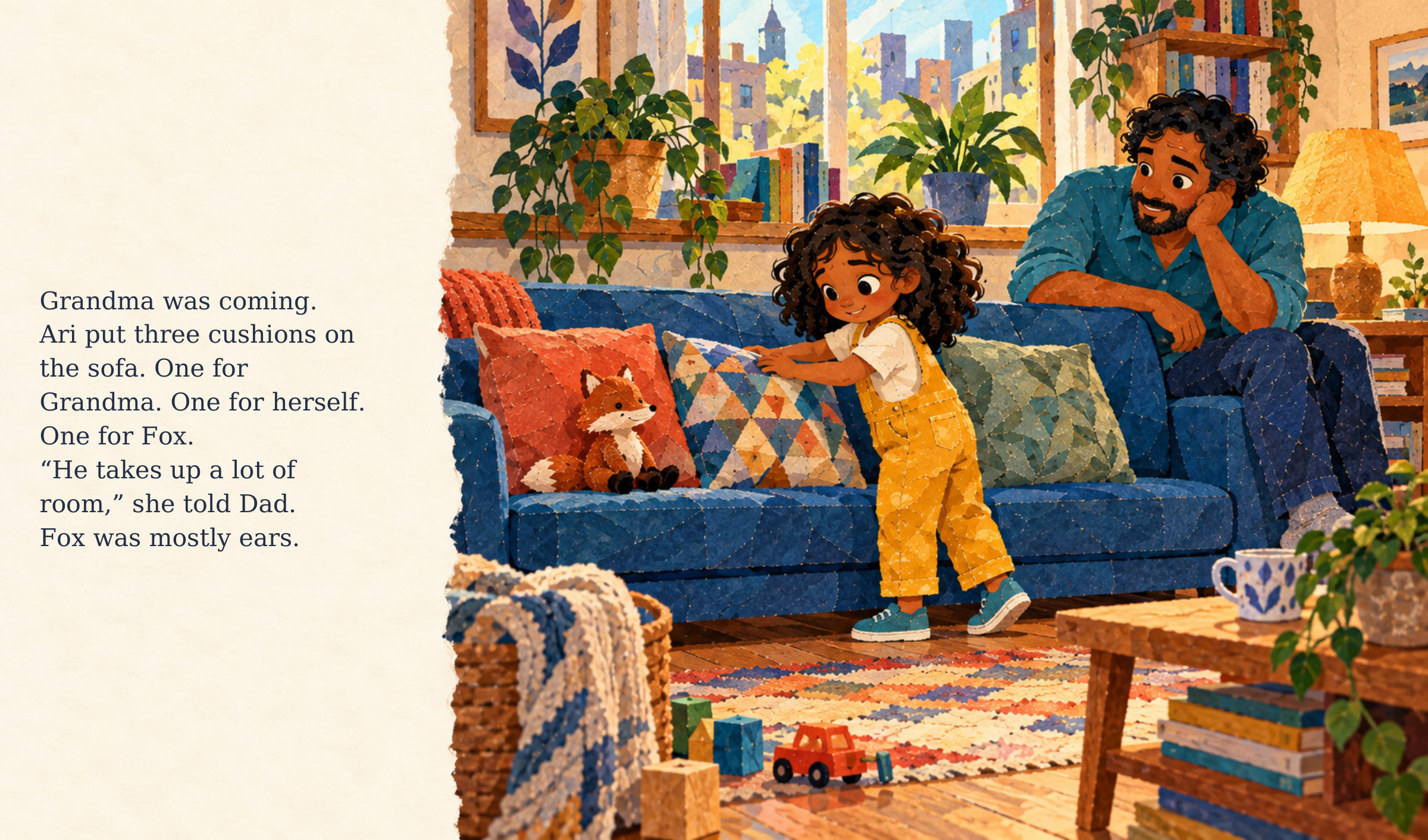
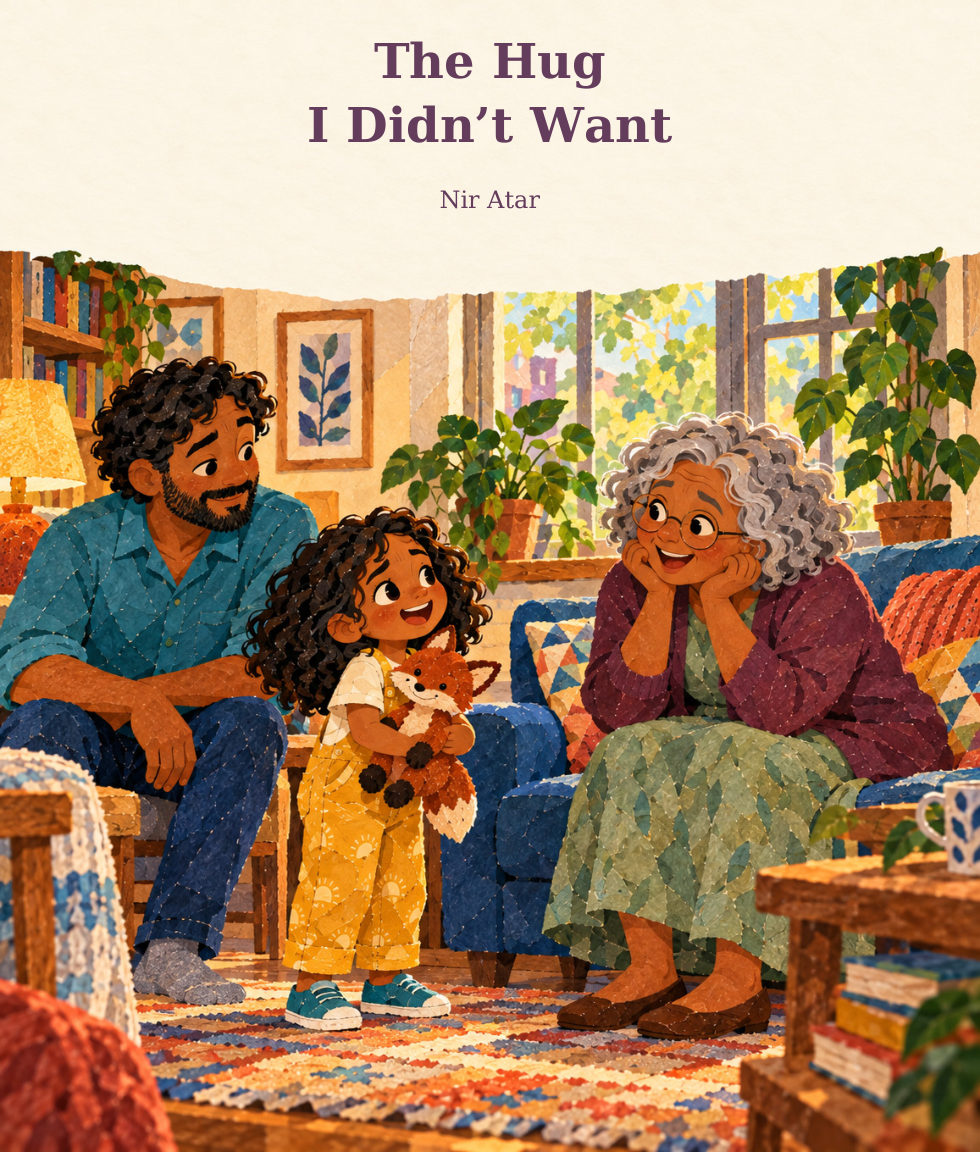
Grandma was coming. Ari put three cushions on the sofa. One for Grandma. One for herself. One for Fox. “He takes up a lot of room,” she told Dad. Fox was mostly ears.
Page 1 of 12
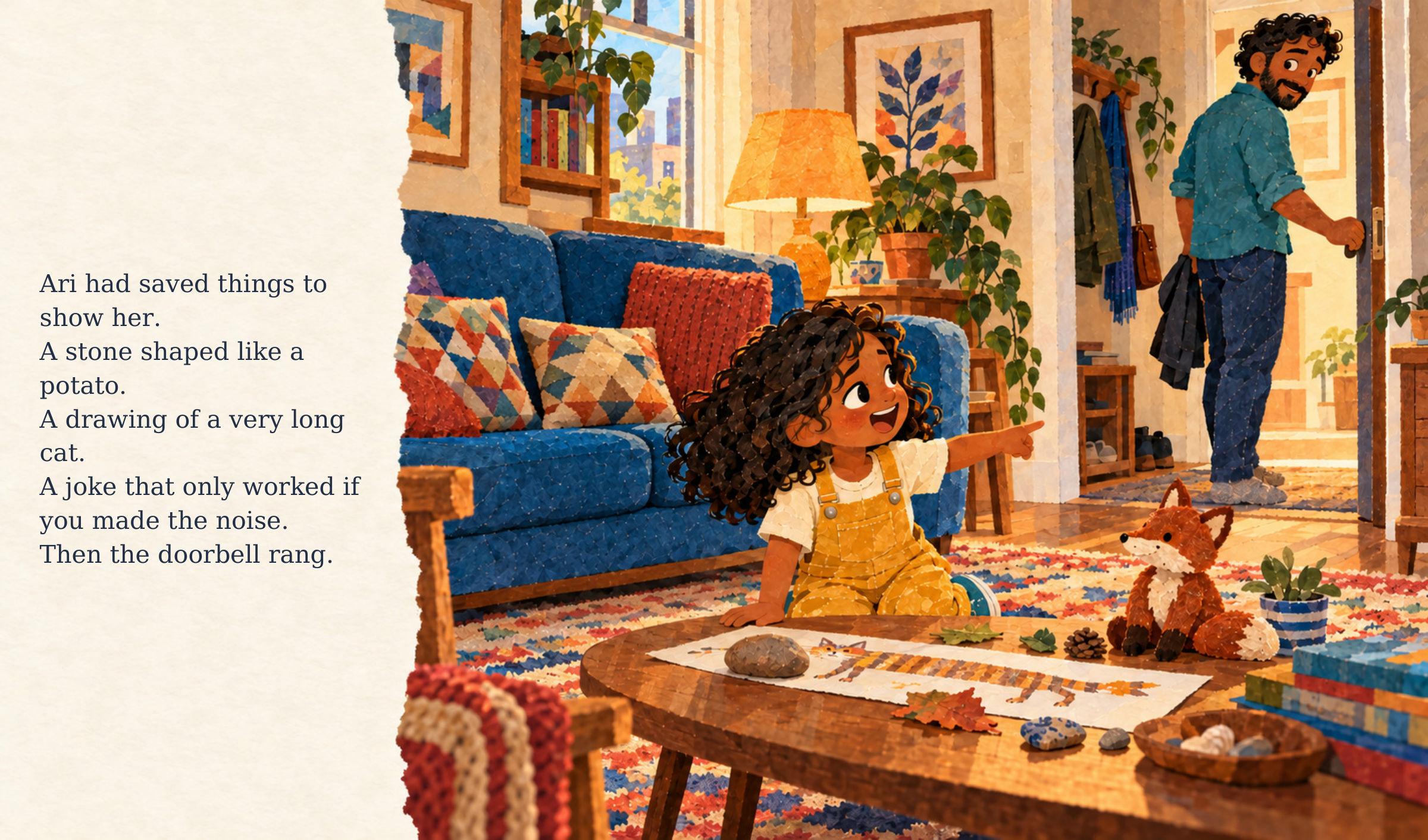
Ari had saved things to show her. A stone shaped like a potato. A drawing of a very long cat. A joke that only worked if you made the noise. Then the doorbell rang.
Page 2 of 12
Who writes these stories
Einat Gur Atar has been writing since she was eight. She studied theater and holds a degree in theater arts from Tel Aviv University. When she became a mother, she went looking for a gentler way to parent, found the Bederech Halev (Way of the Heart) method, and trained as an instructor. She now works with parents and families.
These stories come from what she and Nir learned at home: a parent gets it wrong, and the two of them find the way back, together.
How it works
Digital picture books to read together in our app, on your phone or tablet.
The first shelf
Four stand-alone books about Ari, Fox and Dad. Start with the moment that feels familiar.
A story about a fort that has to come down
Wait, It's Not Just a Blanket
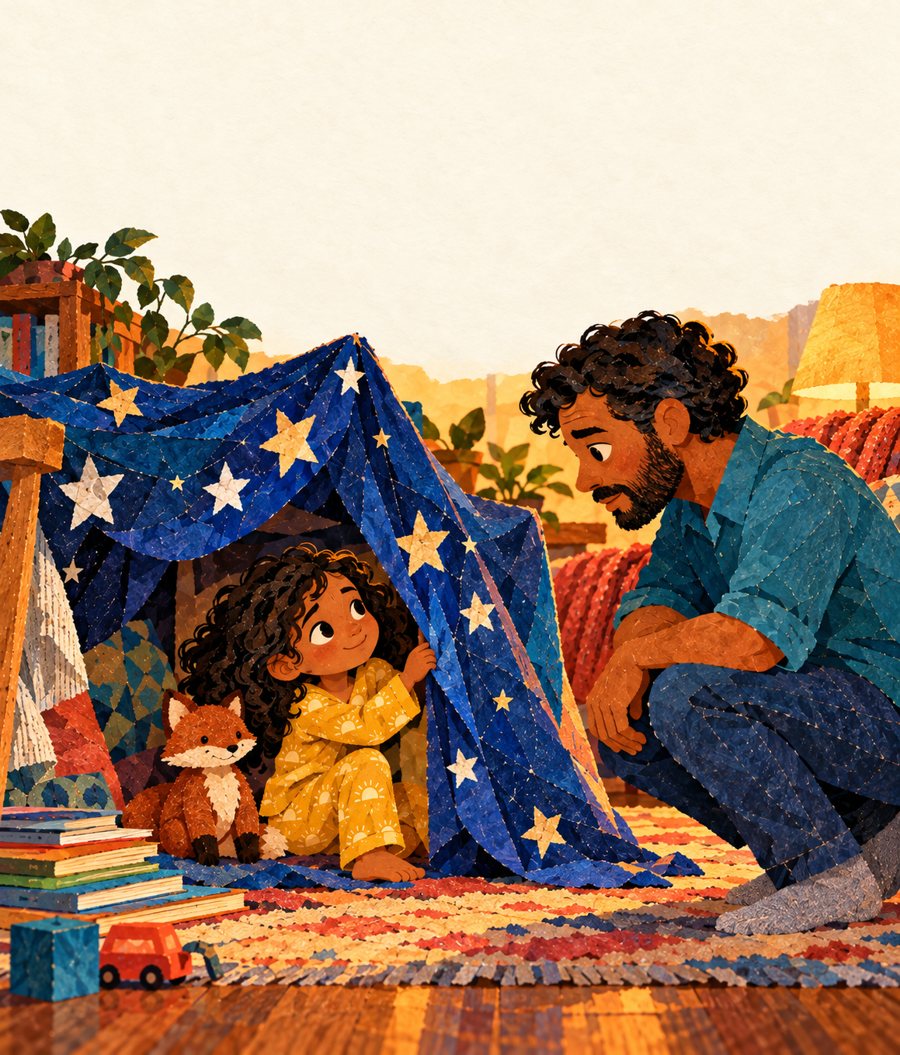
Fox needs a house, so Ari builds him one: a bedroom, a kitchen with one tiny spoon, and a tunnel for visitors. Then it is bedtime, and Dad reaches for the blanket.
When to read it: The night a fort covers the living room and it is already late. Or the morning after you put one away. Not while the roof is actually sliding and someone is shouting.
The schedule is ours. The house on the floor is hers, and it is real. When we put the relationship before the clock, bedtime can stop being a thing we push a child through, and becomes a moment we get to be in.
Read more
Dad says it plainly: “I started taking it apart before I looked.” Most of us know that sentence. The voice that says hurry up is worth noticing before we obey it. Looking first does not cancel bedtime. It changes how we get there.
Tonight, before asking for anything to be put away, we could look first and notice who is hurrying inside us. Then we might ask our child what the chair is for.
A story about a hug she didn't want
The Hug I Didn't Want
Grandma is coming, and Ari has saved everything to show her: a stone shaped like a potato, a very long cat, and a joke that only works with the noise. Then Grandma opens her arms.
When to read it: The day before relatives visit, or after a hello that stalled at the door. Not in the car on the way, with a hug already expected of her.
A child’s body belongs to her. She can love someone and still say no to being held, and that no is not rudeness. It is a boundary, something we practice, not something we demand.
Read more
Dad is the one who asks for the hug. Then he crouches beside her: “You can want Grandma and not want a hug.” Some of us were hugged and kissed on command as children and learned to swallow the no. If we still find it hard to say no to people we love, this story starts with us.
Tonight we could notice one small no of our own we usually skip. Before the next hello, we might ask our child how she wants to say it.
A story about a promise that broke
You Said After Breakfast
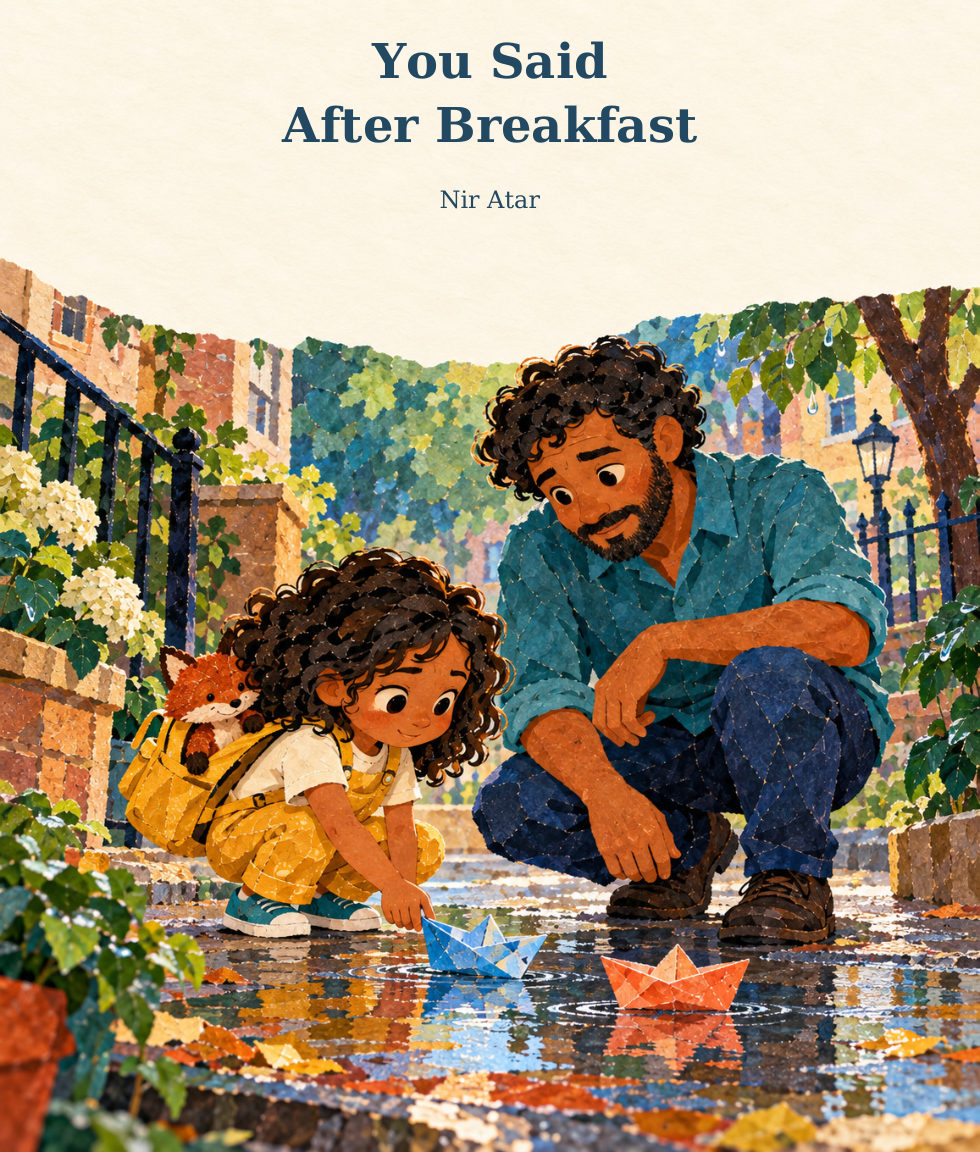
Ari built two boats before breakfast, one for her and one for Dad. “After breakfast,” Dad said. Then it rained.
When to read it: The evening after rain or a canceled plan she had been ready for since waking. Not while the shoe is still upside down on the floor.
A promise we did not keep is a real loss to a child, even when the reason is rain. She does not need cheering up. She needs us to stay beside the disappointment, not hurry her out.
Read more
Dad owns his part in plain words: “I said we would go after breakfast. I didn’t check the weather.” When we let ourselves down, it is worth noticing what we say to ourselves. The way we talk to ourselves about a mistake is part of how our child learns to talk to herself about hers.
Tonight we could try saying one slip of our own that plainly. Then we could let our child be cross and stay close, like Dad on the step.
A story about a voice that got too loud
Dad's Too-Loud Voice
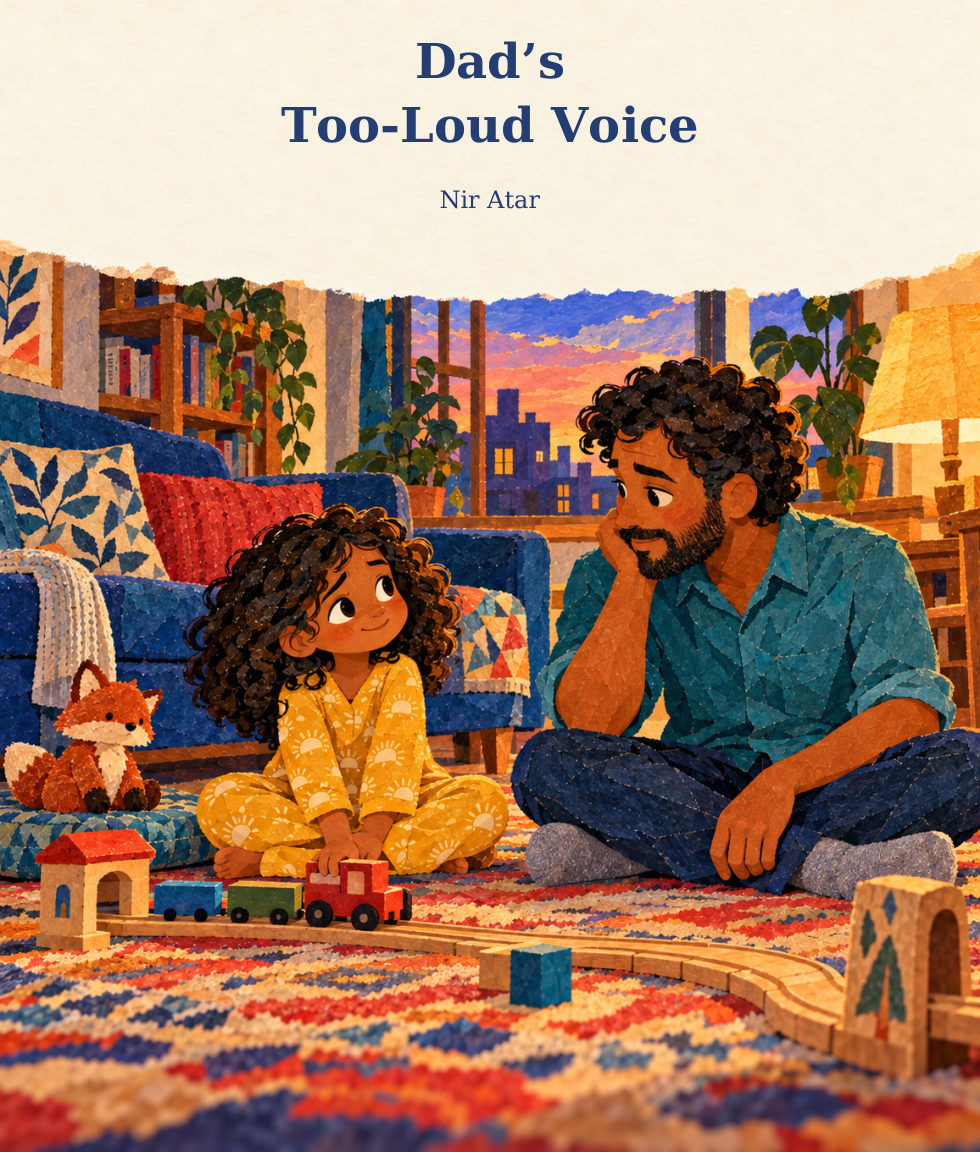
Dad is making dinner, the timer is beeping, and Ari's train is everywhere. Then Dad's voice gets very, very loud.
When to read it: A calm day after a loud one, when your voice has gone quiet and you have both come back. Not while the timer is still beeping.
We all lose it. What matters after is the voice we use on ourselves. Our child may borrow that voice after she loses it too. Repair starts there, then moves outward, slowly, and waits to be let in.
Read more
Ari asks at dinner, through Fox: “Can grown-ups learn quiet voices too?” Dad answers, “Yes,” and then, “We can.” Not I already have. Not I never will. If we were shouted at and then told it never happened, that middle ground may be new to us.
Tonight, if we got loud, we could say to ourselves what we would want her to hear: too loud, and I am practising. Then we could sit down outside the table, as Dad does, and wait.
Price
Pay once. No subscription, no ads.
- All four books above: $36 if you get them one at a time
- $29 works out at $7.25 a book
- A fixed set of these four books. Later books are sold one at a time, $9 each
Already have a launch book? Its $9 goes toward the $29. The app shows your total before you pay.
Get all four books, $29- Any one of the four, pay once
- Read as often as you like
- Shared with your family circle
Where these stories come from
A way of seeing our children
These books come from Einat and Nir's life work: gentle parenting and nonviolent communication, practised at home with their own children. Each story is one small family moment. Underneath it are the same things: seeing a child with kind eyes, practising empathy, love and boundaries, and giving ourselves the kindness we hope our children will give themselves.
Our children are mirrors: they show us what we do, not only what we say, and they learn the kindness we give ourselves. The notes for grown-ups under each book are there for that reason.
How the books are made
We use AI tools to help write first drafts and to create the pictures. Einat and Nir read every word, check every page, and Einat approves every book.
What this is not
Stories, not therapy. These are not a parenting program or a treatment, and nothing in them is a promise about how a child will feel or behave. If you are worried about your child, talk to someone qualified.
Questions
Who are these books for?
Children about 4 to 7, and whoever is reading to them. The books are made for reading together, side by side.
Is it a subscription?
Nope. You pay once and read as often as you like. Nothing renews. Prices are in the Price section.
How do I read the books?
In our reading app, right in the browser on your phone or tablet. Sign in with your email: we send you a link, no password to remember. You can add the app to your home screen like any other app.
Do I need internet to read?
For getting a book, signing in and opening it the first time, yes. After you've added the app to your home screen and opened a book, that book opens without internet too. If you skip the home-screen step, your browser may clear saved books after a while.
Can my partner or the grandparents read them?
Yes, with your family circle. Invite up to 3 people by email and they can read every book you've added to your shelf. They can't pass them on, and anyone in your circle can get their own copy at the single-book price. If you remove someone, their place opens up again after 30 days.
Can I download or print the books?
Not for now. The books live in the app, with no PDF and no printed edition.
What if it's not right for us?
Tell us within 7 days and we'll refund you. One refund per account. The collection is refunded as a whole, and a refunded book leaves your shelf and your circle's shelves.
I got one book. Can I still get the collection?
Of course. You only pay the difference: the $29 minus $9 for each launch book you already have. The app shows the exact amount before you pay.
Do you collect anything about my child?
We don't ask for your child's name, age or photo, and the app has no child profiles. We use your email to sign you in. Details are in our Privacy page.
How are the books made?
With real family life, and some help from AI.
The stories come from Bederech Halev, the gentle-parenting method Einat trained in and now teaches, and from how she and Nir raise their own children. They turned what they learned at home into small stories a parent and child can read together.
We use AI tools to help write the first drafts and to create the pictures. Then Einat and Nir read every word, check every page, and send back anything that isn't right. Einat approves every book. We tell you because you deserve to know what's on your child's shelf.
Not ready yet? Get our emails
We write when a new book comes out. That's all: no daily emails, unsubscribe in one click, and we never ask anything about your child.